Managing Your Identity Can Be Useful When You Are Meeting Someone at a Party for the First Time.
30 Your Interpersonal Communication Preferences
Upon completing this chapter, you should be able to:
- describe each of the three domains of identity as they relate to advice practice,
- explain the relationship between identity and perception, and their influence on achieving shared understanding through communication,
- describe your own communication and work addiction preferences, and
- explain how key factors of diversity influence your workplace behaviours.
This affiliate is all about helping you to uncover your interpersonal advice preferences. When nosotros written report interpersonal communication, we often focus on external things like the audience or surroundings. Those things are important here likewise, but they are important in the context of their bear upon on you.
The affiliate begins with an overview of the three core elements that brand up your identity. Personal identity elements are examined using the five-factor personality trait model, on which many personality tests are built. The second element is your social identity, which would include things like identifying socially every bit an animal rescue volunteer, an entrepreneur, or a marathon runner. The third is your cultural identity, which tin can include elements such as your race, ethnicity or gender.
The side by side section of the chapter takes a deeper look at other elements of your identity. Some elements of your identity are things you choose, known as avowed identity, and some are elements that are put upon you, known equally ascribed identity.
The focus is then turned to perception, including how selective perception tin can often negatively affect interpersonal communication.
The chapter wraps up with information to assistance y'all determine your preferences and work habits, a review of advice channels, and a peek at Belbin's ix team roles that may assist you lot empathise and excel at communicating interpersonally while doing squad piece of work.
Having a better knowledge of your own interpersonal advice preferences will let you to better understand yourself, your identity, and motivations. This awareness is a useful showtime step in developing your abilities to chronicle with and empathise other people also.
Nosotros develop a sense of who we are based on what is reflected back on us from other people. Our parents, friends, teachers, and the media contribute to shaping our identities. This process begins correct after we are built-in, but nearly people in Western societies reach a stage in boyhood in which maturing cognitive abilities and increased social awareness atomic number 82 them to begin to reflect on who they are. This begins a lifelong process of thinking about who nosotros are now, who we were before, and who we volition become (Tatum, 2009). Our identities make up an important part of our cocky-concept and tin exist cleaved downward into three primary categories: personal, social, and cultural identity.
Our identities are formed through processes that started earlier we were born and will continue later we are gone; therefore, our identities aren't something we achieve or complete. Two related but distinct components of our identities are our personal and social identities (Spreckels and Kotthoff, 2009). Personal identities include the components of self that are primarily intrapersonal and connected to our life experiences. For example, I may consider myself a puzzle lover, and you may identify as a fan of hip-hop music. Our social identities are the components of cocky that are derived from involvement in social groups.
Instance identity characteristics
| Personal | Social | Cultural |
| Antique Collector | Member of Historical Society | Irish gaelic Canadian |
| Dog Lover | Member of Humane Society | Male person/Female |
| Cyclist | Fraternity/Sorority Member | Greek Canadian |
| Singer | High School Music Instructor | Multiracial |
| Shy | Book Club Member | Heterosexual |
| Athletic | Entrepreneurial Co-Working Member | Gay | Lesbian | Two Spirited |
Personal identities may change often as people have new experiences and develop new interests and hobbies. A electric current interest in online video games may later give way to an interest in graphic design. Social identities do not change every bit oft, considering they depend on our becoming interpersonally invested and, as such, have more time to develop. For example, if an interest in online video games leads someone to become a member of an online gaming customs, that personal identity has led to a social identity that is now interpersonal and more entrenched.
Cultural identities are based on socially constructed categories that teach u.s. a fashion of beingness and include expectations for social behaviour or ways of acting (Yep, 2002). Since we are often a role of them from nascency, cultural identities are the least changeable of the iii. The social expectations for behaviour inside cultural identities practice change over time, but what separates them from almost social identities is their historical roots (CollIer, 1996). For example, remember of how means of being and interim take changed in America since the ceremonious rights movement.
Common ways of being and acting within a cultural identity group are expressed through communication. In lodge to exist accustomed as a fellow member of a cultural group, members must exist acculturated, essentially learning and using a lawmaking that other group members volition be able to recognize (Collier, 1996). We are acculturated into our various cultural identities in obvious and less obvious ways. Nosotros may literally take a parent or friend tell usa what information technology means to be a man or a woman. We may also unconsciously consume messages from popular civilization that offer representations of gender.
Personal Identity
We will use the V-Factor Model to examine your personal identity. You tin can use the acronym OCEAN to remember the five traits, which are Openness, Conscientiousness, Extroversion, Agreeableness, and Neuroticism. Take a look at the post-obit calibration. Where would you position yourself on the continuum for each of the traits?
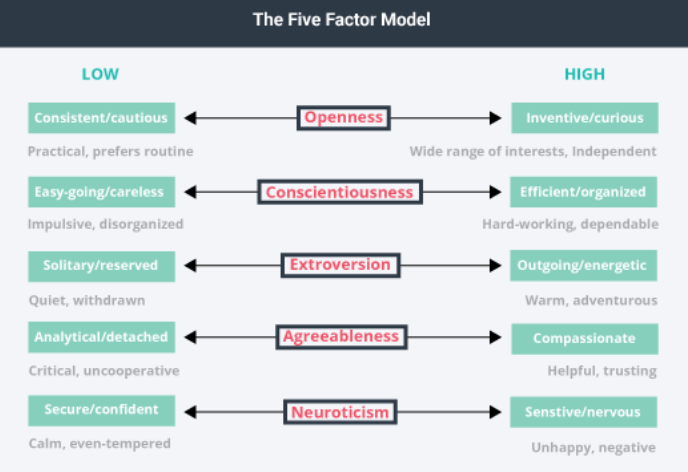
Adapted from OpenStax CNX
These traits have a loftier degree of influence over your working life. They will help you to make up one's mind which career path is right for you; for example, if yous identify as highly extroverted and conscientious with low neuroticism, yous would do well in a sales-oriented position, but someone who identifies on the contrary ends of these scales is unlikely to enjoy or excel at this type of work.
These traits will dictate the people you collaborate with successfully, your team-working ability, and the type of surround you adopt to work in. Your position on the conscientiousness scale tin aid to predict your job operation (Hurtz & Donovan, 2000). For example, people who are highly conscientious are more able to piece of work within teams and are less likely to be absent from piece of work. These traits are also connected to leadership ability (Neubert, 2004). Although it may seem counterintuitive at first, if you score low on the conjuration calibration, yous are more likely to be a good leader. If you consider the sectionalisation between leaders and followers on a team, those who make decisions and voice their opinions when they exercise not agree are promoted to higher ranks, while those who are happy to proceed with the consensus remain followers.
These traits will also influence your overall enjoyment of the workplace feel. For instance, agreeableness and extroversion are indicators that you volition enjoy a social workplace where the environment is gear up up to foster collaboration through an open up office concept and lots of squad-working. Conversely, if you score low on these two traits, that doesn't mean that you will non exist a good worker, but that you might not suit this type of environment. If yous score low on these two traits merely loftier on openness and conscientiousness, you might instead exist an excellent entrepreneur or skilled in creative pursuits such every bit design or storytelling.
Social Identity
Your social identity gives a sense of who you are, based on your membership in social groups. Your social identity tin can too be connected to your cultural identity and ethnicity. For case, if you are nationalistic or take pride in belonging to a particular country or race, this is part of your social identity, every bit is your membership in religious groups. But your social identity can also event in discrimination or prejudice toward others if you perceive the other group as somehow inferior to your own. This can occur innocently enough, at first, for example, through your fidelity to a particular sports squad. As function of your identity every bit a fan of this team, yous might jokingly give fans of a rival squad a hard fourth dimension, merely be cautious of instances where this could become derogatory or fifty-fifty dangerous. For example, if your fellow fans use an insensitive term for members of the rival group, this tin can cause insult and anger.
Cultural Identity
The identifiers that shape your cultural identity are conditions similar location, gender, sexuality, race, ethnicity, nationality, language, history, and religion. Your understanding of the normal behaviour for each of these cultures is shaped by your family unit and upbringing, your social environment, and the media. Maybe unconsciously, you mirror these norms, or rebel confronting them, depending on your environs and the personal traits outlined above.
Your perception of the earth, and the way you communicate this, is shaped past your cultural identity. For example, one of our authors had a white South African colleague who, in casual conversation, used a racial term to refer to black South Africans. While the author was affronted by the colleague'southward use of the term, the author came to realize that this word choice had been a result of the colleague's upbringing. The colleague's parents, friends, and community had been using that term casually; as such, using that racial term in everyday speech was an ingrained behaviour that did non agree the level of offense for him that it did for the community that he was referring to. While the term has always been considered an ethnic slur, white Afrikaans-speaking people used it as a coincidental term to reinforce their perceived superiority during the country'south history, particularly during apartheid. While offensive to those outside of his cultural and social group, the term was used inside it habitually.
Depending on your environment, you may feel societal pressure to accommodate to certain cultural norms. For example, historically, immigrants to English-speaking countries adopted anglicized names so that their names would exist easier to pronounce so that they could more easily fit into the new culture. For example, Giovanni may have been renamed John (equally was the example with Giovanni Caboto, the Italian explorer, more widely known equally John Cabot). Withal, consider how important your own proper name is to your identity. For many of us, our names are a fundamental piece of who we are. Thus, in irresolute their names, these people ended up irresolute an integral element of their self-perception.
The cultural constructs of gender and power oft play a part in workplace advice, as certain behaviours get ingrained. For example, in Canada and the United States, male leaders are typically applauded and thought of as frontwards-thinking when they adopt typically "feminine" traits like collaboration and caring. Those same traits in female leaders are ofttimes considered weak or wishy-washy. Similarly, women who are competitive or assertive are "female person dogs" to be put downwards, whereas men exhibiting these traits are seen as self-starters or get-getters. Information technology is difficult to be a female leader and be socially across reproach in the West.
Most of the states are oftentimes totally unaware of how we enforce or reinforce these norms that prevent women from reaching their full potential in the workplace. Not to mention the implications on how a female person leader might communicate effectively interpersonally. In some authoritarian cultures, information technology is considered inappropriate for subordinates to make middle contact with their superiors, equally this would exist disrespectful and impolite. In some other cultures, women are discouraged from making too much eye contact with men, as this could exist misconstrued as romantic interest. These behaviours and interpretations may be involuntary for people who grew up as office of these cultures.
Ascribed and Avowed Identity
Whatsoever of these identity types can be ascribed or avowed. Ascribed identities are personal, social, or cultural identities that others place on the states, while avowed identities are those that we claim for ourselves (Martin and Nakayama, 2010). Sometimes people ascribe an identity to someone else based on stereotypes. If y'all encounter a person who likes to read science-fiction books, watches documentaries, wears spectacles, and collects Star Expedition memorabilia, you may label him or her a nerd. But if the person doesn't avow that identity, using that label can create friction and may even hurt the other person's feelings. Nevertheless, ascribed and avowed identities tin friction match upward. To extend the previous example, there has been a movement in recent years to reclaim the characterization nerd and turn information technology into something positive, and hence, a nerd subculture has been growing in popularity. For example, MC Frontalot, a leader in the nerdcore hip-hop movement, says that being branded a nerd in school was terrible, merely now he raps about "nerdy" things similar blogs to sold-out crowds (Shipman, 2007). We can run into from this example that our ascribed and avowed identities change over the class of our lives. Sometimes they match up, and sometimes they practice not, just our personal, social, and cultural identities are key influencers on our perceptions of the world.
Perception
Perception is the organization, identification, and estimation of sensory information to represent and understand the surround. The selection, organisation, and interpretation of perceptions tin differ among people. When people react differently to the same situation, part of their behavior can exist explained by examining how their perceptions are leading to their responses.
For example, how do you perceive the images below? What do you see? Ask a friend what they come across in the images. Are your perceptions different?
Naturally, our perception is about much more than simply how we come across images. We perceive actions, behaviours, symbols, words, and ideas differently, as well!
Selective Perception
Selective perception is driven past internal and external factors.
The following are some internal factors:
- Personality: Personality traits influence how a person selects perceptions. For instance, conscientious people tend to select details and external stimuli to a greater degree.
- Motivation: People volition select perceptions according to what they need in the moment. They will favour selections they think volition aid them with their current needs and exist more likely to ignore what is irrelevant to their needs. For instance, a manager may perceive staying nether upkeep every bit the top cistron when ordering safe gear but miss or ignore the demand for high quality.
- Experience: The patterns of occurrences or associations 1 has learned in the by impact current perceptions. For example, if yous previously learned to acquaintance men in business suits with clean-shaven faces or no discernable facial hair as ideal and trustworthy, you may dismiss the same man who shows upwards with a bristles or moustache, perceiving he may have something to hibernate. Such a person will select perceptions in a way that fits with what they found in the by.
When you recognize the internal factors that bear upon perception pick, you as well realize that all of these are field of study to change. You tin change or modify your personality, motivation, or feel. Beingness aware of this is helpful in interpersonal advice because we can use our perceptions as a catalyst for changing what nosotros pay attention to (personality) in club to communicate meliorate (motivation). One time we modify those, nosotros can open ourselves to new patterns (experiences) and means of understanding.
The post-obit are some external factors of selective perception:
- Size: A larger size makes selection of an object more likely.
- Intensity: Greater intensity, in effulgence, for example, besides increases perceptual pick.
- Dissimilarity: When a perception stands out clearly against a background, the likelihood of pick is greater.
- Movement: A moving perception is more likely to be selected.
- Repetition: Repetition increases perceptual selection.
- Novelty and familiarity: Both of these increase option. When a perception is new, information technology stands out in a person's experience. When information technology is familiar, it is likely to be selected because of this familiarity.
External factors tin can be designed in such a way as to impact your perception. Marketers, advertisers, and politicians are extremely well-versed in using external factors to influence perceptual selection. Let'south say you have a long cylinder of ice water in a beautiful drinking glass container next to a short basin of water in a patently, white ceramic container. Nigh people would choose the drinking glass container because it looks bigger and the clarity may make it seem brighter, despite the fact that it contains less water than the bowl. Similarly, you may perceive that brand A is meliorate than make B because you've seen make A in high-way magazines, while make B is more often than not available at discount stores in your local mall. Y'all may pay more for brand A because you perceive you're getting quality when in actuality brands A and B are made from the same material at the same low-price overseas factory.
Perception can influence how a person views any given situation or occurrence, so by taking other people's perceptions into account, we tin can develop insight into how to communicate more finer with them. Similarly, by agreement more than most our own perceptions, we brainstorm to realize that there is more than one way to come across something and that it is possible to have have an incorrect or inaccurate perception about a person or group, which would hinder our ability to communicate effectively with them.
Examine the vignette below and determine which of the 3 types of internal selective perception most closely matches this state of affairs:
The author has taken two trips to the United Arab Emirates (UAE), landing at Dubai Airport. At the time of her visit, a visa was required for Canadians, and, as role of the visa requirements, travellers needed to be digitally fingerprinted and have an center browse.
During her showtime trip at that place was no lineup. She went and was scanned and printed with no problems. On her second trip, she went to the familiar area, just at that place were 2 long lines virtually equal in length. There were no signs to bespeak which line was designated for what, then she didn't know which line to stand in or what the corresponding lines were for.
She looked around and saw some official-looking gentlemen at a nearby booth. She went and said, "Excuse me, sorry to carp you, but I demand to take my visa sorted out and I don't know which line I'm supposed to stand in."
The men looked at her, staring daggers at her. She was perplexed, equally they looked somehow angry or ticked off. Afterwards a long, uncomfortable silence, one of the men piped upwards and said, "You can stand in any line you lot desire, ma'am."
She felt frustrated that they seemed to exist so unhelpful. She was mindful of her acrimony ascent, tried to soften her tone, and said, "I'm not being funny here, but the last time I was here, at that place was no line. Now there are two, and I don't know what they're for because at that place are no signs, then I don't know which line I'm supposed to be in. This is why I came here to enquire for your assistance, so I tin can know which line to stand in."
Finally, the other homo said, "Ma'am you tin can stand up in that line there," pointing to the line that happened to be closest to her.
"Give thanks you," she said, walking away shaking her caput. She was in line and still trying to figure out why those men at the booth had been so cross at her for asking a simple question. Information technology made no sense.
She started looking at the people in her line. They seemed to come from a range of countries, and all looked travel worn. She looked at the other line. Same thing. She wondered, still, why in that location were ii lines.
After doing some shuffling with her bags and passport, about 10 minutes after first standing in line, she had a huge realization. All the people in her line were women or children. All the people in the other line were men.
It took her over x minutes and an uncomfortable conversation to realize that in many Islamic countries, men and women by and large go about their twenty-four hours-to-day lives in separate ways. Her co-ed upbringing had completely blinded her to this reality in this context.
If it were a queue for a washroom, she would have noticed right away, but as a queue for a travel visa, it had genuinely not occurred to her—fifty-fifty after looking at these lines pretty intensely for several minutes—that the reason behind having two lines was that one was for men and the other for women and children.
Suddenly, she too understood that the two gentlemen at the berth had looked at her angrily because they might have thought she either was trying to make a betoken as a smug westerner or was totally dumbo. She laughed and laughed…
Part of perception in a communication context is about how we perceive another person's mood, needs, and emotional land. Nosotros don't e'er say what we actually mean; therefore, some reading betwixt the lines occurs when we are communicating with someone, particularly if their reaction is not what we expect.
For example, when a baby is crying, we, as adults, wonder, Has the baby eaten? Could the babe be tired? Is she uncomfortable or unwell? Has he been startled? Our first thoughts get to meeting the baby'due south bones needs. Conversely, when we have an encounter with an developed who reacts to usa with a negative emotion, we often think, This person is mad at me, He doesn't like me, She's non a squeamish person, or She'southward in a bad mood for no reason. We accept the adult's response personally, but notwithstanding we know instinctively that the baby'south reaction is not about us. Why is it that nosotros react then differently to the baby's behaviour in contrast to the adult'southward, fifty-fifty though the trigger may exist very like? We brand assumptions based on our ain perception, but we are not always right. If we, instead, considered whether or not the adult's basic needs had been met, relationships and emotions in the workplace could be managed more easily. The adjacent time yous have a disagreement with someone, consider whether or not their essential needs are currently being met, and you may observe that the lack of fulfillment of these needs—not something you accept said or done—is playing a part in the person's emotional response.
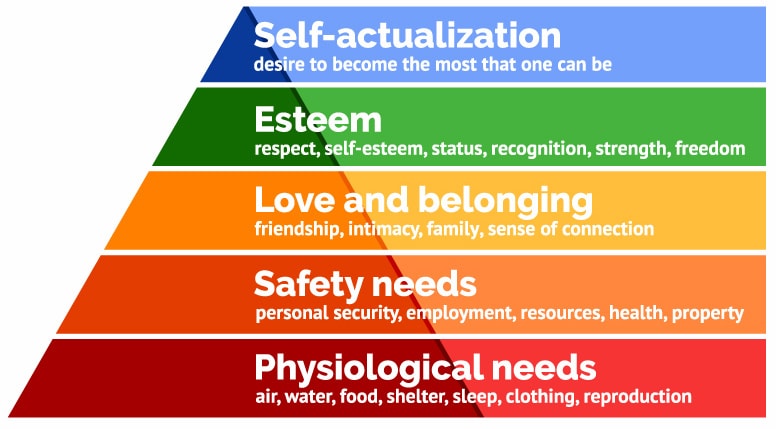
Psychologist Abraham Maslow (Maslow, 1943) described a series of need levels that humans experience. As Effigy 4.2.3 shows, the more basic needs are at the lesser of the pyramid. The almost bones needs must be met before humans will desire and focus their attention on the next level of the hierarchy. This plays a large part in communication—and miscommunication—with other people.
Permit's take a expect at each of these needs, beginning with the most bones:
- Physiological: These are the physical needs required for survival, including air, water, food, wearable, and shelter. Without these, the trunk cannot function.
- Safety: These needs are required for humans to experience secure, and include physical safety, health, and financial security.
- Dear and belonging: These are our social needs and include family, friendship, love, and intimacy.
- Esteem: These are our needs to feel respected by others and to accept self-respect. This level of needs explains why nosotros study, take up occupations, volunteer, or strive to increase our social status.
- Self-actualization: This refers to our desire to fulfill our potential. Each person will approach this need in their own manner. For case, you might aim to become reach able-bodied goals, while your friend may work at developing her artistic skill.
Think about how your basic needs are met in your workplace environment. Practice y'all answer to others differently, or have trouble regulating emotion and mood when your bones needs are not met? This can, unknowingly for some, exist the source of conflict, frustration, and misunderstanding between colleagues.
In a professional person context, Maslow'due south hierarchy is key to employee motivation, happiness, and productivity. We piece of work to earn coin and then that our basic needs will be met. Merely some organizations extend their achieve to further run across employee needs, for case, by providing nutrient, social gatherings, professional development opportunities, career progression, then on. These provisions make the organisation more than appealing to new applicants and encourages existing staff to stay with the visitor.
The personality indicators described above have a significant impact on your working style and preferences. Your previous work feel, demographics, and strengths will as well play a part. You may not have spent much time considering your own preferences and habits, or the impact of these on the people you lot work with. So, let's take a few moments to expect at this.
Ask yourself:
- Do you lot enjoy working in a sociable surroundings, or exercise you adopt to work in a more solitary surround?
- Do yous feel more energized through coming together people and building relationships or from coming upwardly with cracking ideas?
- Are you a big-picture show person, or practise you focus on the fine details?
- Is your conclusion-making process based more on logic or on feelings?
- At what time of twenty-four hour period practise you experience near productive?
- What practices help you lot stay organized?
- Practise you adopt to accept a planned, orderly approach to your work, or a more flexible and spontaneous arroyo?
- Which of your previous working environments did you discover most enjoyable? Why?
- Which communication channels practise you lot employ, most commonly?
- What have previous colleagues and managers said near your skills and working process? Which elements have come upward in performance reviews as things you excel at? What have you struggled with in the past?
- What are the demographics and traits of people you have worked all-time with in the by? With whom have yous had conflicts and misunderstandings, and what do yous recall were the causes of these?
Practice you remember the communication channels we discussed in the Foundations module? These have an touch on the mode your message is received in whatever type of communication but are particularly important when you are communicating interpersonally. Your communication preferences are part of your interpersonal fashion, merely when deciding which aqueduct to utilize to communicate information to others, you will demand to consider which channel is best for the situation.
For example, peradventure y'all are a millennial who prefers to communicate on-the-go using mobile devices and quick-response channels similar text, social media, or instant bulletin. But you might struggle to use these channels efficiently if your colleagues are primarily from the baby boomer generation, because your preferences might not marshal.
You lot may recall the term communication richness, first discussed in the Foundations module. The channels considered to exist the most rich are those that transmit the virtually non-verbal information, such as, for case, face-to-face conversations or video conferencing. Channels that communicate verbal information, such equally phone calls, for example, are less rich. The least rich channels use written communication, such as email or postal mail. Depending on the details of your message, you volition identify the most effective channel to utilise. For instance, if yous need a response right abroad, if y'all anticipate an emotional response, or if your message needs to remain in strict confidence, you will need to use a highly data-rich channel. If your bulletin is not urgent, intended for data only, and directed to a large grouping of people, you might choose a less rich aqueduct. For a refresher on this concept, review the Choosing a Communications Channel Chapter of the Foundations module.
Belbin'due south (1981) team inventory is a model that helps people to identify what strengths and weaknesses they tin bring to a group or team. Normally, people fill out a questionnaire that helps decide what their superlative three squad strengths are out of ix possible categories. According to Belbin's enquiry, these categories are stable across cultures. The nine categories are listed in the chart beneath:
| Action-Oriented Roles | Shaper | Implementer | Completer | Finisher |
| People-Oriented Roles | Coordinator | Squad Worker | Resource Investigator |
| Thinking-Oriented Roles | Found | Monitor-Evaluator | Specialist |
Research Break
- Find definitions or profiles for each for the nine team roles.
- Add the definitions or profiles to the Padlet below.
- Reflect on the post-obit questions and add to Padlet every bit appropriate:
- Which superlative three roles do yous retrieve y'all align most with?
- Practise you have a mix of action, people, and thinking-oriented roles, or practice your team strengths fall in one or two of those categories?
- Have yous worked with others who seem to conspicuously match one or more of the definitions you lot've uncovered?
How you carry on a team and what strengths come to the surface usually depends on who else is on the team at least as much as your own personality traits and strengths. But because Belbin's team roles look at your top iii strengths, you tin can unremarkably find a role on a team that plays to your strengths and have others take the lead in areas where you either are weaker or have little involvement.
These squad roles are some other aspect of a diversity that allows and encourages people to bring their strengths and experiences to the table to solve bug or introduce. Having this framework helps increase the likelihood of interpersonal communication and team synergy because team members understand one another's strengths and weaknesses and can make up one's mind their preferred squad function(s).
In this chapter you learned nigh your own preferences and tendencies for communicating interpersonally as a foundation for understanding yourself and others better.
You examined several elements that brand upward your identity: these are the personal, social, and cultural aspects as well as ascribed and avowed identity.
Learning about perception and selective perception helped you to empathise that there is more than 1 way to see something and that we sometimes choose to meet but what we want to run into. You learned that incorrect or inaccurate perception tin can go in the way of effective interpersonal communication.
Finally, you lot examined your work preferences and habits, reviewed your preferred advice channels, and researched where yous might best lend your talent and experience to a team using Belbin'southward Squad Role framework.
This ameliorate understanding of your interpersonal communication preferences is the grounding you lot should find useful in the next chapter on cantankerous-cultural advice.
- Your identity consists of iii main elements: personal, social, and cultural.
- An easy way to call up the five-factor personality model is by using the acronym OCEAN (openness, conscientiousness, extroversion | introversion, conjuration, neuroticism).
- Ascribed identity is given to you, while avowed identity is what you cull for yourself.
- Perception is the organization, identification, and interpretation of sensory information to correspond and understand the environs.
- Belbin's team inventory is a nine-category model that helps people to identify the top 3 categoric strengths they can bring to a group or team.
Farther Reading and Links
- BBC Time to come article on optical illusions – How your Eyes Fox Your Heed
References
Belbin, Yard. (1981). Direction Teams. London; Heinemann.
Collier, M. J. (1996). Communication competence problematics in ethnic friendships. Communications Monographs, 63(iv), 314–336.
Hurtz, One thousand. M., & Donovan, J. J. (2000). Personality and job performance: The Big V revisited. Periodical of Applied Psychology, 85, 869–879.
Maslow, A. H. (1943). A theory of human being motivation. Psychological review, fifty(4), 370.
Martin, J. Due north., & Nakayama, T. Yard. (2010). Intercultural advice in contexts.
Neubert, S. (2004). The Five-Factor Model of Personality in the Workplace. Retrieved from http://www.personalityresearch.org/papers/neubert.html.
Shipman, T. (2007, July 22). Nerds Get Their Revenge as at Last It's Hip to Exist Square. The Telegraph. Retrieved from http://www.telegraph.co.uk/news/worldnews/1558191/Nerds-get-revenge-at present-its-hiphoped-for-square.html.
Spreckels, J., and Kotthoff, H. (2009). Communicating Identity in Intercultural Advice. In Kotthoff, H., and Spencer-Oatey, H. (Eds.), Handbook of Intercultural Communication. Berlin: Mouton de Gruyter.
Tatum, B. D. (2000). The complexity of identity: Who am I. Readings for diversity and social justice, 9–xiv.
Yep, G. (2002). My Three Cultures: Navigating the Multicultural Identity Mural. In Martin, J., Flores, L., and Nakayama, T. (Eds.), Intercultural Communication: Experiences and Contexts Boston, MA: McGraw-Hill.
Attribution Statement (Your Interpersonal Communication Style)
This chapter is a remix containing content from a diversity of sources published under a multifariousness of open licenses, including the following:
Chapter Content
- Original content contributed by the Olds College OER Development Team, of Olds College to Professional Communications Open Curriculum under a CC-BY 4.0 license
- Content created by Anonymous for Foundations of Culture and Identity; in A Primer on Communication Studies, previously shared at http://2012books.lardbucket.org/books/a-primer-on-communication-studies/s08-01-foundations-of-culture-and-ide.html nether a CC BY-NC-SA 3.0 license
- Content originally created by Boundless for The Perceptual Process; in Boundless Management published at https://www.boundless.com/direction/textbooks/boundless-direction-textbook/organizational-behavior-5/individual-perceptions-and-behavior-41/the-perceptual-procedure-217-3560/ under a CC BY-SA iv.0 license
- Figure X.X, Multistability by Alan De Smet published at https://en.wikipedia.org/w/alphabetize.php?title=File:Multistability.svg&page=ane in the public domain
- The 5 Factor Model, adapted from: © Dec 9, 2022 OpenStax Psychology, originally published at http://cnx.org/contents/Sr8Ev5Og@iv.100:Vqapzwst@2/Trait-Theorists. Textbook content produced by OpenStax Psychology is licensed under a Creative Commons Attribution License 4.0 license.
Bank check Your Understandings
- Original assessment items contributed past the Olds College OER Evolution Squad, of Olds College to Professional Communications Open Curriculum under a CC-Past 4.0 license
Source: https://ecampusontario.pressbooks.pub/profcommsontario/chapter/your-interpersonal-communication-preferences/
0 Response to "Managing Your Identity Can Be Useful When You Are Meeting Someone at a Party for the First Time."
Post a Comment